
Is the $550 Chase Sapphire Reserve Worth It in 2026? The Real Net Math Breakdown
We deduct the $300 travel credit, factor 3x multipliers, and calculate your exact 1-year net cash return across $500–$2,500 monthly spend.
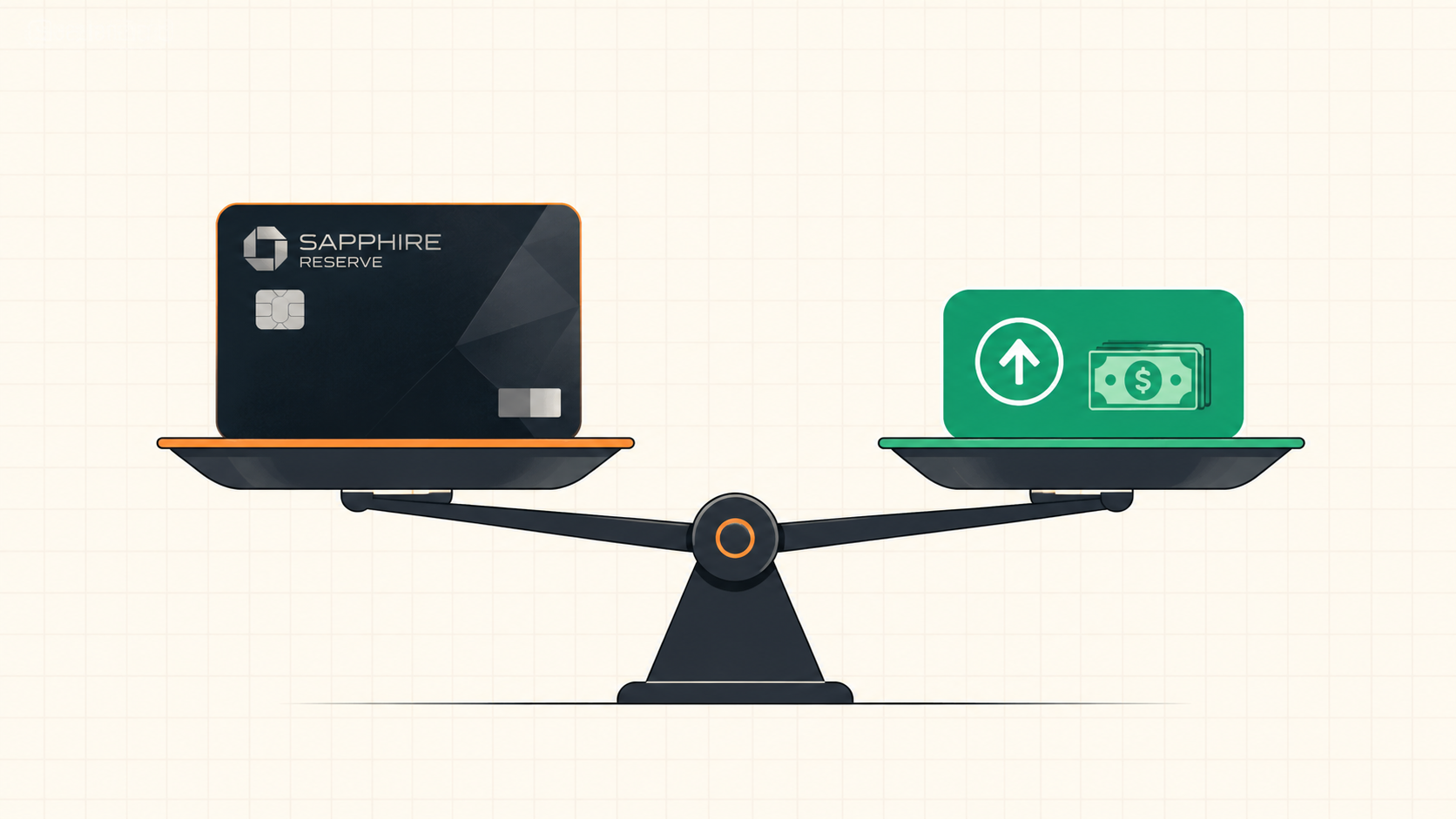
Review blogs love to tell you that a $550 annual fee credit card is "basically free" because it comes with a bundle of statement credits you might only use half the time. They showcase the 60,000-point sign-up bonus in giant bold font, omit the fee math, and pocket a $250 commission when you click apply.
We prefer mathematics over affiliate marketing.
The Chase Sapphire Reserve®is one of America's premier travel rewards cards, but paying $550 upfront requires a cold, objective financial audit. Below is the exact 1-year net ROI breakdown—factoring in annual fee friction, the $300 travel credit, point valuation standards, and three realistic monthly spending profiles ($500/mo, $1,200/mo, and $2,500/mo).
1. The Real Effective Annual Fee: $550 - $300 = $250
Before evaluating point multipliers or lounge access, you must calculate the card's Effective Annual Fee.
Unlike premium cards that force you to track $10 monthly rideshare credits or $7 coffee vouchers, Chase handles its flagship travel credit with zero friction.
The $300 Travel Credit Mechanics
The $300 Annual Travel Credit automatically applies to the first $300 spent on any travel category each account anniversary year. Under Chase's broad travel definition, this includes:
- Airline tickets, hotel stays, and Airbnb bookings.
- Uber, Lyft, taxi rides, and parking garages.
- Subways, commuter trains, tolls, and cruise lines.
Real Effective Annual Fee: $250 ($550 sticker price – $300 direct travel credit).
2. Standardized Point Valuations: What Are 60,000 Chase Points Worth?
Credit card points are not created equal. 60,000 points on a generic portal might be worth $300, while 60,000 Chase Ultimate Rewards® points carry a baseline valuation of 1.50 cents per point ($900 cash value).
Chase Sapphire Reserve® cardholders unlock two distinct redemption paths:
- Chase Travel Portal (1.50¢/pt Fixed Value): Points are worth 50% more when redeemed directly for flights, hotels, or rental cars through Chase Travel. 60,000 points = $900 in travel.
- Airline & Hotel Transfer Partners (1.50¢ – 2.00¢+ Average Value): Points transfer 1:1 to premium partners like World of Hyatt, United Airlines, Air Canada Aeroplan, and British Airways. Transferring 60,000 points to Hyatt for 3 nights at a $350/night luxury resort yields $1,050+ in cash value.
3. Side-by-Side Comparison: Reserve vs. Preferred
| Card Feature | Chase Sapphire Reserve® | Chase Sapphire Preferred® |
|---|---|---|
| Sticker Annual Fee | $550 | $95 |
| Direct Travel Credit | $300 (Automatic) | $50 (Hotel Portal) |
| Effective Annual Fee | $250 | $45 |
| Travel Multiplier | 3x Points | 2x Points |
| Point Redemption Value | 1.50¢ per point | 1.25¢ per point |
| Airport Lounge Access | Priority Pass™ + Sapphire Lounges | None |
| Net First-Year Value | +$945 Net ROI | +$805 Net ROI |
4. Spend Profile Audits: Is It Worth It for Your Spend?
Moderate Spender
$500/month in Dining & Travel ($6k/yr)
Profitable in Year 1 due to welcome bonus. In Year 2, consider the Sapphire Preferred unless lounge access is critical.
Active Traveler
$1,200/month in Dining & Travel ($14.4k/yr)
Clear Win. 3x multipliers and 1.50¢ point redemption generate $398 pure profit every year after fee offset.
Road Warrior
$2,500/month in Dining & Travel ($30k/yr)
Slam Dunk. Primary car insurance + trip delay protections make this an indispensable business travel tool.
5. Frequently Asked Questions
Is the Chase Sapphire Reserve worth it if I only travel twice a year?
Yes, provided those two trips utilize the $300 travel credit and you spend at least $300/month on combined dining, food delivery, and local transit. The $300 credit applies to subways, tolls, and Ubers—not just flights.
What is the Chase 5/24 rule and does it apply to the Reserve?
Yes. Chase will automatically decline your application if you have opened 5 or more personal credit cards from any bank within the past 24 months.
Is the 60,000-point welcome bonus taxable?
No. The IRS treats credit card welcome bonuses earned through spending requirements as a tax-free purchase rebate rather than taxable income.
Model Your Own Net ROI
Don't rely on static review tables. Calculate your exact 1-year net profit based on your actual monthly spend inputs using our conflict-free engine.